American Journal of Healthcare Strategy
AJHCS Healthcare Strategy Institution Building
I helped build AJHCS from an early healthcare strategy publication into a broader institution for practitioner-led research, executive conversation, education, internships, journalism, and platform-enabled publishing. The work combined company building, editorial governance, software infrastructure, audience development, and my own healthcare strategy research.
- Next.js
- Directus CMS
- Cloudflare R2
- Render
- Publishing workflows
- founder work
- healthcare strategy


Project note
In Brief
I helped build AJHCS from an early healthcare strategy publication into a broader institution for practitioner-led research, executive conversation, education, internships, journalism, and platform-enabled publishing. The work combined company building, editorial governance, software infrastructure, audience development, and my own healthcare strategy research.
Relevant To
- healthcare publication operators
- healthcare strategy leaders
- academic healthcare researchers
- students and interns in healthcare administration
- founders building expert media
Search Context
- how to build a healthcare strategy publication
- how to create a healthcare research and education institution
- healthcare journal platform operations
- healthcare strategy journalism and internship model
- practitioner-led healthcare publishing model
7 cited sources
Operating Context
Healthcare strategy has a public-knowledge problem. Serious operating insight often lives in conference conversations, consulting decks, executive meetings, graduate classrooms, and unpublished practitioner experience. AJHCS was built to give that knowledge a credible public home through research, journalism, education, podcasts, and practical strategy writing.
The American Journal of Healthcare Strategy began as an early publication experiment after Syed Siddiqi reached out to me on LinkedIn. At the start, it was closer to a small publication with early articles than a mature healthcare strategy institution. The opportunity was to turn it into a company and public intellectual platform.
What We Built
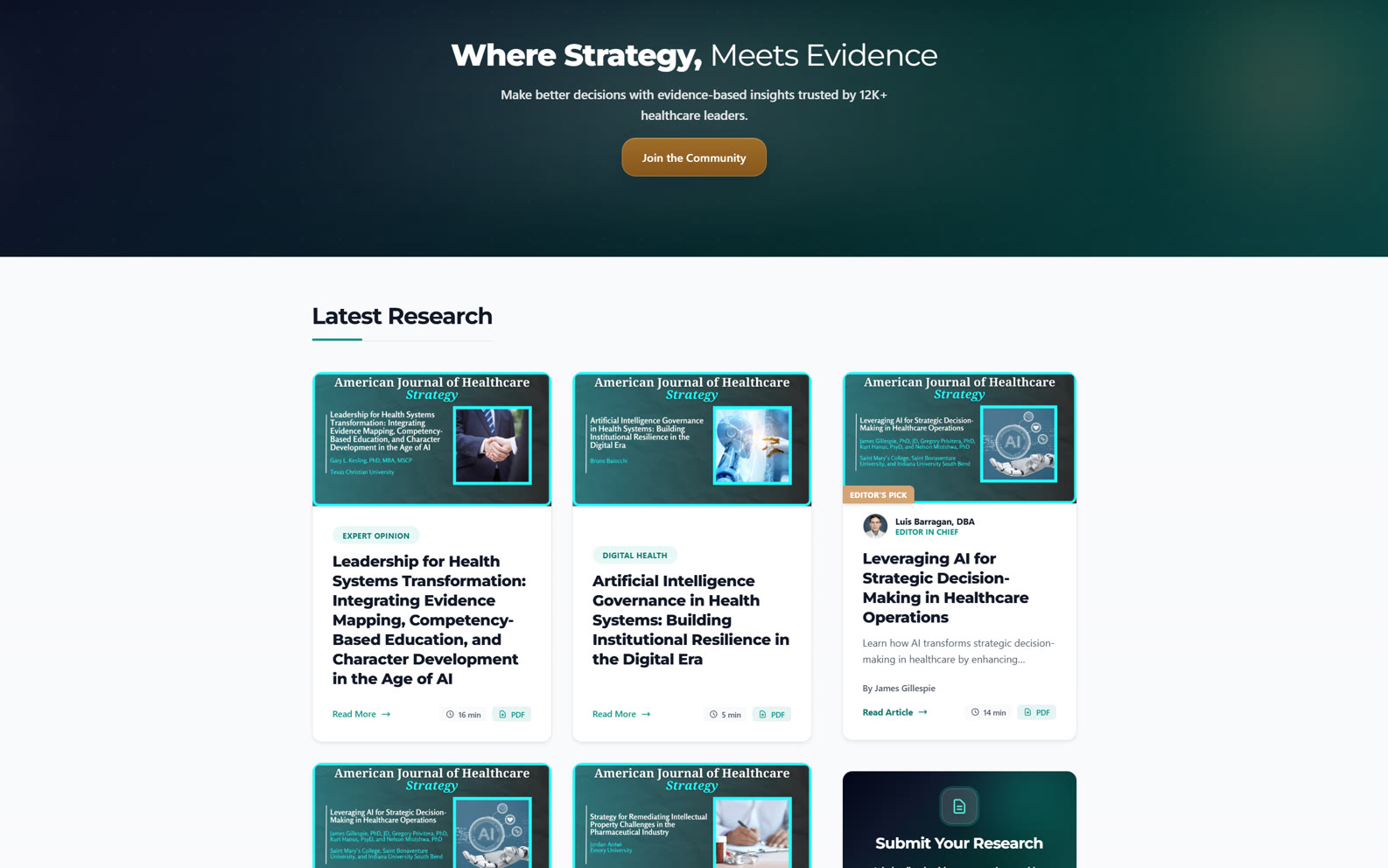
AJHCS became a healthcare strategy institution with multiple operating surfaces: an open-access publication, podcast network, executive audience, educational pathway, internship platform, journalism outlet, research home for my own work, and mission-oriented company model.
My role combined founder-level company building with hands-on platform ownership:
- building executive relationships and maintaining healthcare strategy conversations
- producing and hosting podcast work connected to healthcare leadership
- supporting editorial development, publication operations, and contributor pathways
- creating space for academic-style healthcare strategy research outside a traditional university department
- leading educational programs and internship work for students interested in healthcare administration, strategy, journalism, and analytics
- helping more than 20 interns and early-career contributors publish in the journal and use that work toward jobs, graduate programs, residencies, PhD programs, law programs, and administrative fellowships
- designing and building the current AJHCSv3 software platform
I designed and built AJHCSv3 as a production Next.js frontend powered by Directus CMS, Cloudflare R2, testing infrastructure, and Render deployment. The platform supports articles, podcast pages, structured metadata, publication workflows, author profiles, strategy insights, bookstore and commerce products, sponsorship workflows, institutional access, admin functions, newsletter infrastructure, RSS, sitemap, and SEO health.
The technical signal is the institution around the website: editorial operations, audience development, platform infrastructure, research capacity, and talent-development pathways.
The company model matters too. AJHCS was built in the spirit of a mission-oriented company: there is a method for earning revenue, but the point is to use that company structure to create ownership, support research, train people, and keep healthcare strategy knowledge public rather than trapped inside private institutions.
The same pattern appears in the JHP knowledge pipeline and Penn AQM evaluation: make messy healthcare knowledge inspectable, governed, and useful enough that other people can act on it.
Implementation Playbook
The reusable model is to build the publication as an institution first and a content system second. A healthcare strategy platform needs editorial credibility, research discipline, software infrastructure, educational pathways, and sustained executive conversation.
The operating model I would use again:
- Define the institutional thesis. AJHCS is not generic healthcare content; it exists at the intersection of healthcare delivery, strategy, leadership, innovation, policy, and operations.
- Separate editorial judgment from publishing mechanics. Content management, podcast feeds, newsletters, SEO, social distribution, and media storage are infrastructure. They should support the editorial standard, not replace it.
- Build repeatable formats. Peer-reviewed articles, practitioner essays, podcasts, strategy briefs, interviews, and journalism pieces should reinforce the same institutional identity.
- Create contributor and intern pathways. Writers, students, researchers, and operators need clear expectations for submissions, review, revisions, publication timing, authorship, and feedback.
- Make education part of the operating model. The internship and educational program should teach students how to read healthcare strategy, write clearly, cite sources, interview practitioners, and turn messy healthcare questions into public work.
- Use journalism to widen the institution. Healthcare strategy needs academic research, timely coverage, interviews, explainers, and analysis that help operators understand what is changing.
- Connect publication to career mobility. If students and early-career operators publish serious work, they should be able to use it in fellowship applications, graduate applications, job searches, and professional conversations.
- Choose the business structure intentionally. A mission-oriented company model can preserve a revenue engine while keeping the institution accountable to research, education, and public knowledge.
- Instrument the platform. Subscriber growth, impressions, downloads, article traffic, podcast retention, referral channels, and newsletter engagement all help decide what to build next.
- Keep the founder close to the market. The best insight came from conversations with healthcare leaders, not analytics alone.
Standards, Governance, And Validation
For healthcare publishing, governance is product infrastructure. Readers need to know who is speaking, why they are credible, how work was reviewed, what conflicts may exist, and how the institution handles corrections, ownership, editorial independence, and source quality.
The governance model for a healthcare strategy institution should include:
- visible mission, editorial scope, team, submission, ethics, and correction pages
- role clarity between founders, editors, authors, interns, sponsors, and contributors
- publication-ethics alignment with COPE and open-access transparency principles from DOAJ
- healthcare-journalism norms around accuracy, independence, transparency, and public accountability, using AHCJ principles as a practical reference point
- clear distinction between peer-reviewed articles, practitioner essays, journalism, sponsored content, educational material, and founder opinion
- citation discipline for public claims, especially metrics, policy statements, market analysis, and clinical or operational assertions
- review workflows for sensitive healthcare topics and claims that could be mistaken for medical, legal, or investment advice
- internship expectations that build communication, critical thinking, technology fluency, professionalism, and career readiness
- outcome tracking for interns and contributors, including publication, job placement, graduate-school placement, administrative fellowship progress, residency progress, or other next-step outcomes
- public-benefit and commercial-boundary clarity so revenue supports the institution without distorting editorial judgment
A credible journal cannot rely on vibes and landing pages. It needs durable content structures, metadata, author records, source records, review states, and governance pages that make trust visible.
Results And Evidence
AJHCS is public-facing and reports a national healthcare leadership audience. Current public-facing proof points include:
| Signal | Current Posture | Evidence Note |
|---|---|---|
| Podcast scale | 200+ podcast episodes reported publicly | Refresh against AJHCS podcast pages during future content updates. |
| Audience | 13,000+ subscribers and 500k monthly impressions reported publicly | Approved for portfolio use; current public page language should be checked during future content updates. |
| Funding | $100k in seed funding | Approved for portfolio use; add public source if available. |
| Internship outcomes | 20+ interns and early-career contributors published in AJHCS, with reported 100% success across job placement, university placement, administrative fellowship guidance, law program acceptance, PhD program acceptance, residency program acceptance, or related next-step outcomes | Approved for portfolio use; names and individual outcomes stay out unless separately approved. |
| Company model | Mission-oriented company model | Approved concept; avoid exact legal certification wording. |
| Institution scope | Open-access healthcare strategy journal, podcasting, education, internships, journalism, and research | Public AJHCS pages support the journal and podcast positioning. |
| Platform | Next.js, Directus CMS, Cloudflare R2, Render, SEO, RSS, newsletter, article and podcast infrastructure | Internal implementation detail, supported but not externally audited. |
The practical outcome is an open-access healthcare strategy institution with peer-reviewed articles, executive podcasts, public strategy writing, educational and internship pathways, a mission-oriented company model, and a technical platform capable of supporting publication operations, discovery, commerce, sponsorship, and institutional workflows.
The work is strongest in combination:
- founder work: developing an institution, audience, partner interest, and executive network
- operator work: repeatedly producing, publishing, distributing, and maintaining the work
- research work: creating a serious public space for healthcare strategy questions, including my own research agenda
- education work: giving students and early-career healthcare people a way to publish, learn interviewing, write publicly, analyze strategy, use evidence, and convert that work into career mobility
- engineering work: building the production platform and content infrastructure directly
- journalism work: helping healthcare strategy ideas move from private conversations into public analysis
My Operating View
My strongest view is that healthcare strategy needs institutions between the university, the consulting firm, the trade publication, and the conference stage. Universities can be rigorous but slow. Consulting firms often have deep operating knowledge but keep it private. Trade publications can be timely but may not have room for methods, nuance, or original research. Conferences create excellent conversations that often disappear when the room clears.
AJHCS is my attempt to build in that gap. It gives healthcare operators, researchers, students, executives, and writers a place to turn strategy work into a public body of knowledge.
I also think the educational piece matters more than people realize. Healthcare administration students are often asked to become strategic thinkers without being trained to write, interview, cite, analyze markets, explain operational tradeoffs, or publish their thinking in public. AJHCS became a training ground because interns and early-career contributors did real publication work and left with public evidence of what they could do.
The intern outcomes are one of the clearest signs that the institution worked. More than 20 contributors published through the journal, and the reported downstream outcomes were excellent: jobs, university placement, administrative fellowship guidance, law program acceptance, PhD program acceptance, residency program acceptance, and related next steps. The work developed talent alongside content.
The business lesson is that institution building is different from content production. Content can be produced quickly. Institutions are built through repeated trust signals: consistency, governance, editorial judgment, technical reliability, relationship depth, a business model aligned with the mission, and a point of view strong enough to attract people who want to contribute.
Reusable Checklist
For someone building a healthcare research, education, and publication institution, I would use this checklist:
- Write the institutional thesis in one paragraph.
- Define the content types: peer-reviewed research, practitioner essays, journalism, podcasts, explainers, student work, sponsored work, and founder notes.
- Create public standards for submissions, review, authorship, conflicts, corrections, and sponsored material.
- Build a contributor pipeline with clear roles for executives, academics, clinicians, operators, students, and journalists.
- Design internship tracks around real outputs: literature scans, interview briefs, article editing, source checking, podcast research, data analysis, and publication operations.
- Require every intern or early-career contributor to leave with a public output when appropriate: article, podcast support credit, research brief, editorial product, or source-checked publication contribution.
- Track next-step outcomes: job placement, graduate program acceptance, residency placement, fellowship progress, law or PhD program acceptance, and references provided.
- Build platform primitives before scaling: article metadata, author profiles, references, canonical URLs, RSS, podcast pages, newsletter capture, media storage, and analytics.
- Separate metrics by purpose: audience growth, editorial throughput, podcast performance, intern learning, research output, sponsorship interest, company development, and platform reliability.
- Maintain a source ledger for public claims and institutional metrics.
- Use conferences and executive conversations as research inputs and distribution moments.
- Revisit the operating model quarterly so the publication does not drift into generic content.
Project material AJHCS institution-building operating map
A practical operating map connecting editorial governance, research programs, internships, journalism, podcasts, audience development, metrics, and platform engineering.
References
The public AJHCS and Open-Informatics pages support the strongest external proof points: AJHCS positioning, public role language, the podcast library, open-access journal framing, subscriber and impression metrics, and the 200+ episode scale.
COPE and DOAJ provide the strongest public references for publication governance, open-access transparency, conflicts, review, ownership, and correction norms. AHCJ provides a journalism reference point for accuracy, independence, and public accountability. NACE provides a practical early-career framework for internship design.
The major operating claims used here are the $100k seed funding, 13,000+ subscribers, 500k monthly impressions, 200+ podcasts, the mission-oriented company framing, and the 20+ published intern/contributor outcomes. Individual intern names and specific placement stories remain off-page unless separately approved.
Frequently Asked Questions
- How do you build a healthcare strategy publication?
- Define a clear editorial thesis, separate editorial judgment from distribution mechanics, build repeatable article and podcast formats, create contributor and internship pathways, treat publication ethics as infrastructure, instrument the platform, and stay close to healthcare leaders.
- How can a healthcare publication support academic research and education?
- It can combine peer-reviewed articles, practitioner essays, podcasts, student internships, editorial training, literature review support, research briefs, conference coverage, and public-source strategy analysis inside one governed publication system.
- What does a healthcare strategy institution need beyond a website?
- It needs editorial governance, contributor pathways, research standards, student training, podcast and article operations, citation support, audience development, analytics, sponsorship workflows, institutional access, and public pages for mission, submissions, ethics, and corrections.
- Why does publication governance matter for healthcare strategy content?
- Healthcare readers need to know who is speaking, why they are credible, how work was reviewed, what conflicts may exist, and how the institution handles corrections, ownership, and editorial independence.
Cited Sources
- About AJHCS American Journal of Healthcare Strategy
Public source for AJHCS mission, open-access positioning, team listing, and reported impact metrics.
- Podcast Gallery American Journal of Healthcare Strategy
Public source showing the AJHCS podcast library and current podcast count.
- Open-Informatics Open-Informatics
Public source for AJHCS platform metrics, including 13,000+ subscribers, 500k monthly impressions, and 200+ podcast episodes.
- COPE Core Practices Committee on Publication Ethics
Reference point for publication ethics, editorial process, peer review, conflicts of interest, and journal governance.
- Principles of Transparency and Best Practice in Scholarly Publishing Directory of Open Access Journals
Open-access publishing reference for transparency around ownership, editorial process, fees, licensing, and publication practice.
- Principles of the Association of Health Care Journalists Association of Health Care Journalists
Reference point for healthcare journalism norms around accuracy, independence, transparency, and public accountability.
- Career Readiness Competencies National Association of Colleges and Employers
Reference point for internship and early-career program design, including communication, critical thinking, technology, professionalism, and career development.