Penn AQM Customer Service Workshop Evaluation
A Penn Medicine case study of a customer-service workshop evaluated with Automated Quality Monitoring, matched comparison agents, and a quasi-difference-in-differences design.
Role
Analyst and researcher
Penn Medicine, University of Pennsylvania Health System Patient Engagement Center October 2025–April 2026
My role and where the work stands
My role in the work
I was the analyst and researcher responsible for the analysis and research/poster work. William R. Stewart, Manager of Quality, and Kristi M. Madden, Manager of Training, are full coauthors whose substantial contributions shaped the design, training, messaging, and leadership communication; Penn Medicine owns the public historical poster.
Where it stands
The matched quasi-difference-in-differences evaluation estimated higher Courtesy Phrases and Positive Language after the workshop, with a nonsignificant Average Call Duration balancing result whose interval still permits a possible increase.
Contents
The question was whether training changed an observable habit
A patient should hear clear acknowledgement during an efficient call. At Penn Medicine's Patient Engagement Center, Automated Quality Monitoring (AQM) identified an opportunity to improve that language. We wanted to know whether a customer-service workshop changed what agents said, beyond recording who attended.
The project and evaluation ran from October 2025 through April 2026. It became Evaluating a Customer Service Workshop: A Difference-in-Differences Analysis of Contact Center Agent Performance, presented during Patient Access Collaborative (PAC) Annual Symposium poster programming in Columbus on May 14, 2026.
From a measured opportunity to a fair comparison
Training and operations partners selected Courtesy Phrases and Positive Language as the primary AQM behaviors. The workshop used examples, practice, and reinforcement around the small words that make acknowledgement audible in a call: “Can I please have your name and date of birth?” and “Thank you” after a patient answers. This is a representative acknowledgement scene, not a quoted transcript.
The evaluation included workshop attendees with sufficient pre/post Verint AQM observations and contemporaneous comparison agents with usable data matched on available baseline and operating context. The poster gives no numeric observation threshold. We compared how the attendees' scores changed with how matched comparison agents' scores changed over the same period. This is a matched, quasi-experimental difference-in-differences (DiD) design. It is not randomized evidence and does not prove that training alone caused every observed change.
Evidence folio
The symposium poster
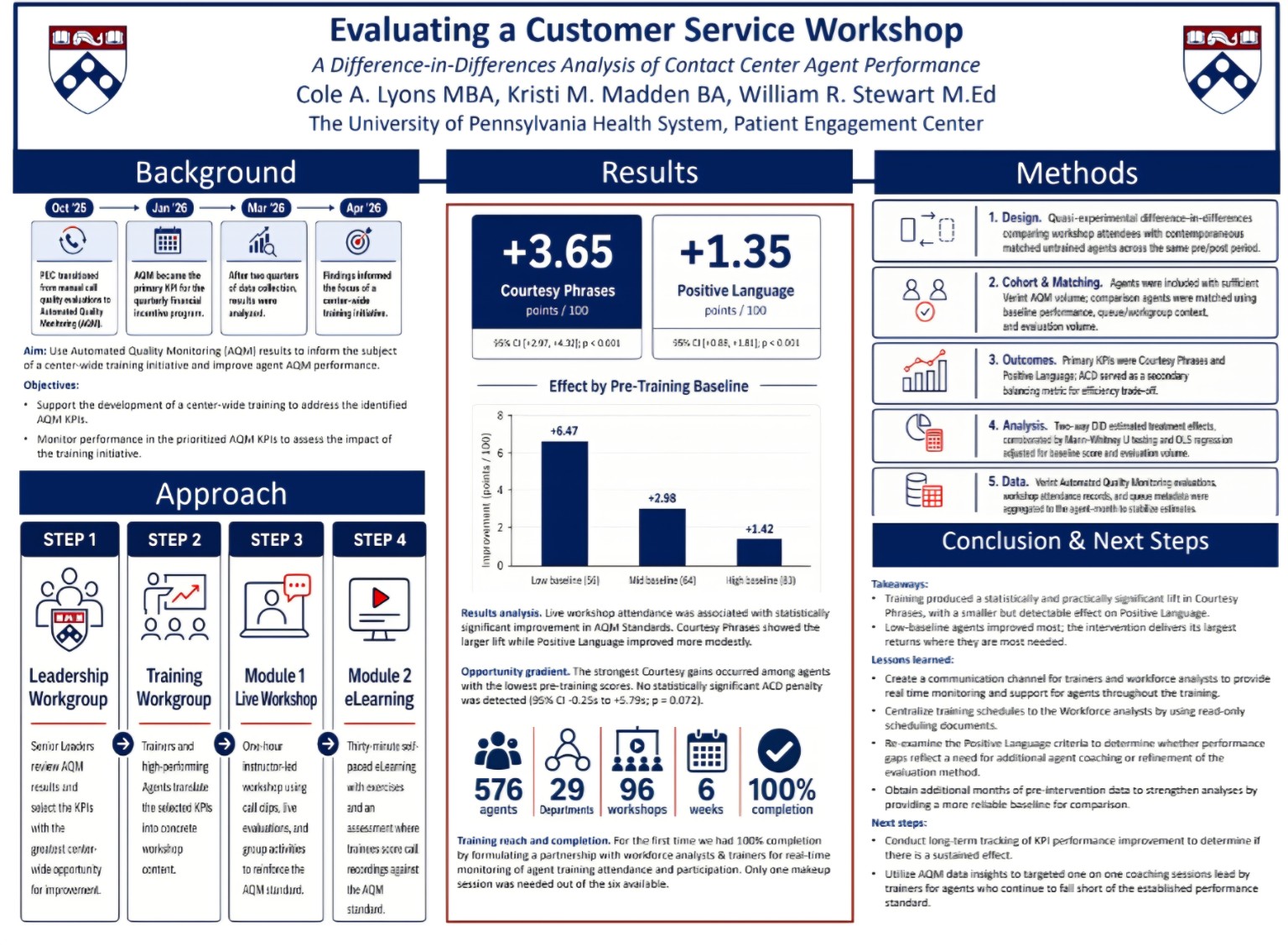
The Penn Medicine poster describes the workshop, matched quasi-difference-in-differences design, language estimates, balancing result, and limitations. A text transcript accompanies the original raster PDF.
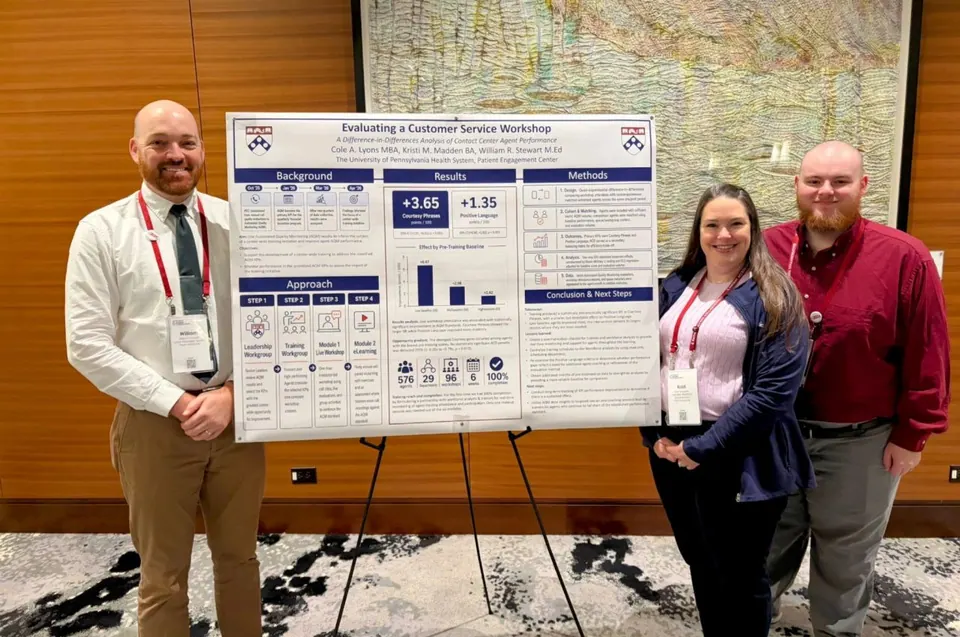
Cole A. Lyons, Kristi M. Madden, and William R. Stewart presented the poster during Patient Access Collaborative Annual Symposium programming in Columbus on May 14, 2026.
Download the historical raster poster (PDF, 0.4 MB).
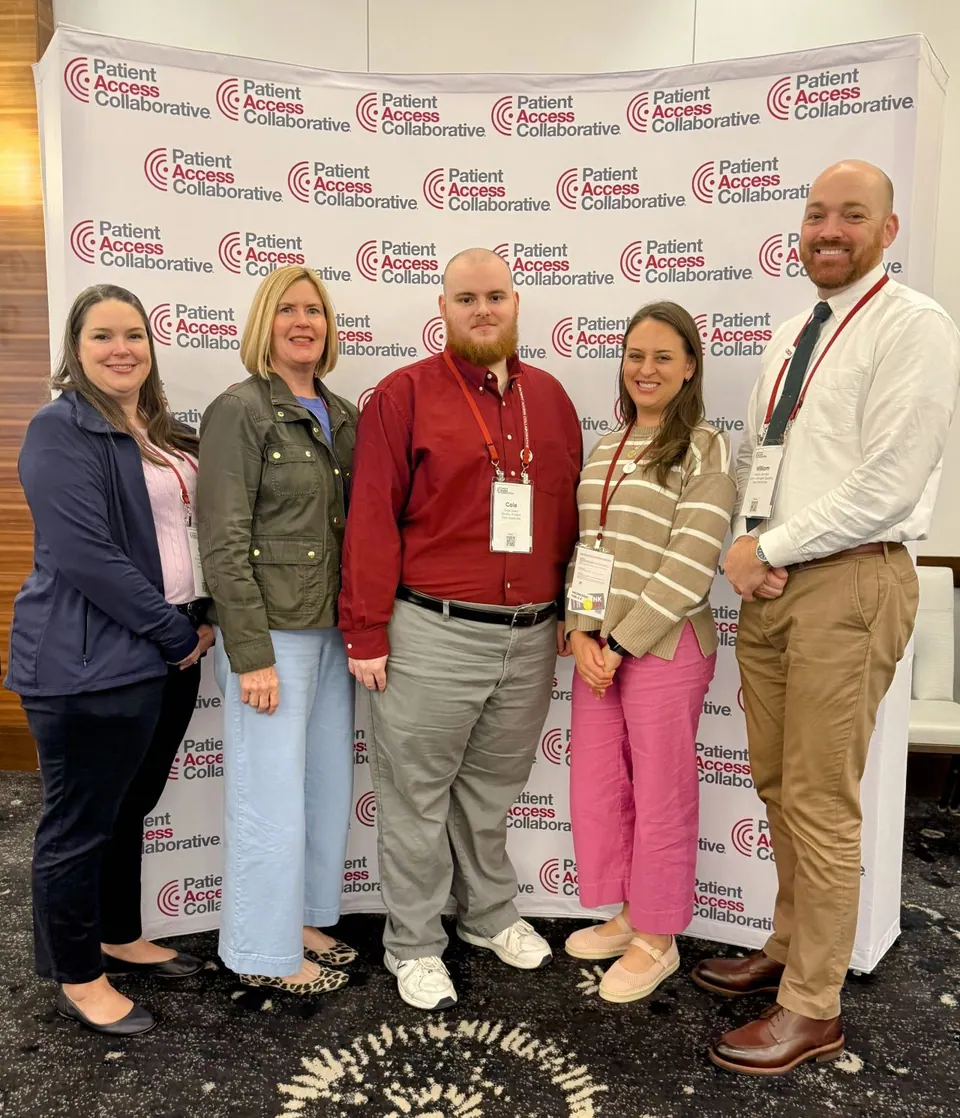
The wider Penn team gathered at the symposium in Columbus.
What the estimates say
The two primary language measures moved upward relative to the matched comparison agents. The estimates below are reported exactly in points per 100, with their confidence intervals and p-values.
Difference-in-differences estimates
Measured service language changed after the workshop
Data table
| Measure | Reported estimate | 95% CI | p-value |
|---|---|---|---|
| Courtesy phrases | +3.65 | +2.97 to +4.33 | < 0.001 |
| Positive language | +1.35 | +0.88 to +1.81 | < 0.001 |
| Average call duration | Not reported | −0.25 to +5.79 | 0.072 |
Courtesy Phrases rose +3.65 points per 100 (95% CI +2.97 to +4.33, p < 0.001). Positive Language rose +1.35 points per 100 (95% CI +0.88 to +1.81, p < 0.001). These workshop-associated estimates come from a quasi-DiD comparison rather than a randomized trial; Mann-Whitney U testing and OLS adjusted for baseline score and evaluation volume corroborated the primary analysis.
Average Call Duration (ACD) was the balancing metric, with a 95% CI of −0.25 to +5.79 seconds and p = 0.072; the poster does not provide an ACD point estimate. Because the interval crosses zero, this nonsignificant result leaves the time cost unresolved and cannot support a zero-cost claim.
The opportunity gradient can guide the next coaching study
Courtesy Phrases showed a descending baseline gradient: +6.47 points per 100 for low-baseline agents, +2.98 for mid-baseline agents, and +1.42 for high-baseline agents.
Opportunity gradient
The lift was largest where the baseline was lowest
Data table
| Baseline tercile | Courtesy-phrase gain |
|---|---|
| Low baseline | +6.47 |
| Mid baseline | +2.98 |
| High baseline | +1.42 |
The gradient suggests where coaching may be useful and what a subsequent evaluation should test. Regression to the mean may contribute, even with a contemporaneous matched comparison. The subgroup pattern is a coaching signal, not a precise causal contrast.
Scale, completion, and credit
The poster reports 576 agents across 29 departments, 96 workshops, and six weeks of delivery. The 100% completion figure refers only to the included training cohort; it is not participation by every agent, every invitation, or the entire Patient Engagement Center.
I was the analyst and researcher responsible for the analysis and research/poster work. William R. Stewart, Manager of Quality, and Kristi M. Madden, Manager of Training, are full coauthors. Their substantial contributions shaped the overall design, training, messaging, and leadership communication. Training and operations partners created and delivered the workshop and enabled the evaluation. Penn Medicine owns the public historical poster.
What the evidence supports, and what comes next
Under a matched, quasi-DiD design, the workshop was associated with higher measured Courtesy Phrases and Positive Language; those indicators connect observable behavior with fair training, coaching, and operational learning while retaining the denominator, comparison, and uncertainty. The poster's roadmap is practical: add more pre-intervention months, follow the cohort longer to test whether improvement persists, use AQM data for targeted coaching, and continue reviewing Positive Language criteria when a gap may reflect either coaching need or evaluation method.
Notes
The AHRQ CAHPS measures PDF and AHRQ patient-experience overview describe helpful, courteous, and respectful staff as dimensions of patient experience. This evaluation measured language, not patient-reported experience.
Hewitt and colleagues' 2009 naturalistic study, Front desk talk, distinguishes task-centred interaction from polite language and rapport. It is context for the acknowledgement scene, not evidence that these phrases alone cause trust or satisfaction.
The 2024 JAMA research synthesis on word choice supports a broader role for wording in empathy, competence, trust, and encounter outcomes without isolating “please” or “thank you” as sufficient causes.
The official 2026 PAC symposium agenda records the May 14 poster programming. O'Neill and colleagues' controlled pre/post methods comparison explains the assumptions and comparison choices required for difference-in-differences.