Jefferson Health
Clinical Floor Formation At Jefferson Neurology
My medical assistant work at Jefferson Neurology turned a credential into an operating foundation. I learned outpatient neurology, prior authorization, Epic documentation, physician and APP workflows, and the patient-level friction that later shaped my population health, AI validation, and healthcare strategy work.
- Clinical Medical Assistant Certification
- Epic documentation
- Outpatient neurology
- Prior authorization
- Epilepsy and migraine workflows
- clinical operations
- medical assistant
Project note
In Brief
My medical assistant work at Jefferson Neurology turned a credential into an operating foundation. I learned outpatient neurology, prior authorization, Epic documentation, physician and APP workflows, and the patient-level friction that later shaped my population health, AI validation, and healthcare strategy work.
Relevant To
- healthcare strategy professionals
- population health leaders
- pre-medical and health administration students
- clinical operations teams
- healthcare AI builders who need clinical-floor context
Search Context
- how medical assistant work shapes healthcare strategy
- clinical operations lessons from outpatient neurology
- why prior authorization matters in healthcare operations
- how clinical certification supports population health work
6 cited sources
In Brief
My medical assistant work at Jefferson Neurology turned clinical certification into operating judgment. It taught me how care actually moves: rooming, documentation, specialty medication access, prior authorization, clinician handoffs, patient trust, and the hidden administrative work that determines whether a care plan becomes real.
Why It Matters
I wrote this for healthcare strategy professionals, health administration students, population health teams, and healthcare AI builders who have not spent enough time close to the clinical floor.
It also explains why my work often moves between patient outreach, access-center analytics, AI validation, Medicare Stars, Epic workflow, and institution building. The bridge is not theoretical. I learned healthcare by doing front-line work first.
Operating Context
I did not start in healthcare strategy. I started by trying to become useful in a clinic.
Earlier in my education, I had been pulled between engineering and medicine. I liked engineering because I liked figuring systems out, but I did not want to spend my life only writing code, and the math path did not feel natural at the time. I then moved toward the physician route: biology, public health, pre-medical coursework, and the practical need to get clinical hours.
At UNC Charlotte, while studying biology and public health, I completed medical assistant training during the period when COVID was winding down and clinical training opportunities were still constrained. I had passed the exam and done the textbook work, but I did not yet have the in-person clinical repetition that turns a credential into usable skill.
Then my wife and I moved toward Philadelphia. We wanted a city, less dependence on a car, and a better next chapter. I applied to public health and healthcare programs across Philadelphia and was admitted widely, including Jefferson’s Health Services Management path. I also applied to clinical jobs. My practical decision rule was simple: the organization willing to train me clinically would be the place where I would finish my bachelor’s degree.
Jefferson Health did that. I joined Jefferson Health Neurology outpatient practice at 909 Walnut Street and learned the clinical floor there.
What We Built
This formation period created the operating base for the work that came later.
The work was human, procedural, and clinical:
- a medical assistant credential converted into real outpatient practice
- Epic documentation habits
- patient rooming and clinical intake discipline
- neurology vocabulary across epilepsy, migraine, and complex specialty care
- exposure to deep brain stimulation equipment and migraine Botox workflows
- prior authorization skill in a high-friction specialty medication environment
- physician, nurse practitioner, and physician assistant workflow literacy
- patient-communication judgment
- the bridge into population health work that required clinical credibility
I was promoted quickly into Medical Assistant II responsibilities and also carried public outreach-coordinator positioning. The title matters less than the work: I learned how specialty care actually happens when patients, clinicians, schedulers, documentation, payer rules, and medication access collide.
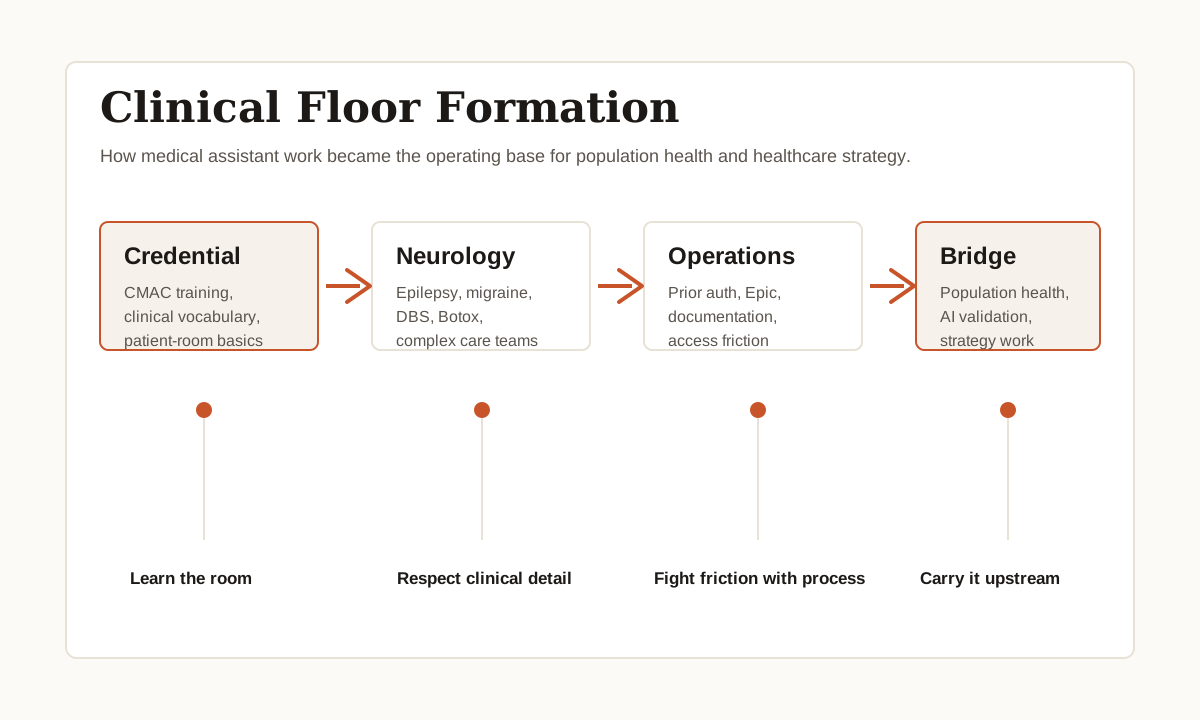
Clinical Floor Formation Map
The core sequence was credential, clinical floor, operating friction, then population health. The clinical floor made the later systems work less abstract.
Implementation Playbook
The reusable lesson is not “become a medical assistant.” The lesson is that healthcare operators need direct contact with the work before they design around it.
For students, analysts, AI builders, and strategy teams, I would turn this into a playbook:
- Get close enough to care delivery that you can name the actual work inside the department.
- Learn how intake, rooming, documentation, medication lists, callbacks, orders, authorizations, and follow-up actually move.
- Shadow across roles. Physicians, APPs, medical assistants, nurses, schedulers, authorization staff, and front-desk teams each see a different system.
- Pick one administrative burden and learn it deeply. For me, prior authorization became one of those burdens.
- Watch where clinical nuance breaks generic process design.
- Learn the source-of-truth systems. If Epic says one thing, the payer portal says another, and the patient says a third, the operator needs a reconciliation habit.
- Notice which work is invisible to leadership dashboards.
- Separate patient inconvenience from clinical risk. Some friction is annoying. Some friction delays therapy.
- Carry clinical-floor lessons into population health, access, AI, and strategy without pretending they are interchangeable domains.
- Keep humility. A few months on the floor can make someone a much better operator while still leaving clinical judgment with clinicians.
Standards, Governance, And Validation
The governance standard here is patient safety and confidentiality. I am avoiding patient-identifying details, individual clinician names, VIP references, and specifics that could point to a case. The operating pattern matters; the private clinical story does not belong here.
The validation standard was practical:
- Could I perform clinical support work reliably?
- Could I document in the right system with the right clinical context?
- Could I understand when something needed clinician review?
- Could I support prior authorization work without treating it as paperwork detached from patient care?
- Could I help the practice expand capacity without losing sight of patient need?
- Could I carry this clinical credibility into population health work later?
Prior authorization deserves its own governance note. In neurology, authorization is clinical operations, not clerical trivia. For patients with epilepsy, migraine, and complex neurological disease, medication access can shape continuity, safety, and quality of life. That does not mean every requested therapy is automatically appropriate. It means the process has to be treated with clinical seriousness.
Results And Evidence
The evidence is mostly first-person operating evidence.
| Signal | What It Shows |
|---|---|
| Jefferson trained me into hands-on outpatient neurology work | The credential became practical clinical-floor experience with day-to-day workflow consequences. |
| Promotion into Medical Assistant II responsibilities | The role expanded quickly because the work became useful to the practice. |
| High prior authorization exposure | Neurology taught me how payer friction affects real care plans, especially specialty medication workflows. |
| Shadowing across clinicians and APPs | I learned how physicians, nurse practitioners, PAs, and clinical support staff experience the same operating system differently. |
| Later population health role required clinical grounding | The medical assistant credential and practice experience helped me move into population health on a clinician-led team. |
I am not claiming quantified patient outcomes from this period. The result is more foundational: I learned that healthcare operations need more than dashboards, financial models, or strategy decks.
My Operating View
Clinical work changed my tolerance for abstraction.
Before this, I understood healthcare as biology, public health, and administration. Jefferson Neurology made it concrete. A patient does not experience “access” as a metric. They experience whether someone answers, whether the message is clear, whether the medication is approved, whether the rooming process catches the right detail, whether the clinician has enough context, and whether the system follows through.
Prior authorization was one of the strongest lessons. I became good at fighting through payer friction because the work had consequences. In complex neurology, the administrative layer can determine whether a patient stays on therapy, switches therapy, waits, gives up, or keeps trusting the care team.
That experience still shapes how I think about healthcare AI. A model that summarizes a policy, classifies a call, drafts an outreach message, or answers a benefit question has to be judged against real workflow. Who reviews it? What source of truth does it use? What happens when the patient is anxious, the payer rule is ambiguous, or the clinical detail matters? The clinical floor made those questions feel obvious.
This page pairs with the iScribe documentation internship before it and the Epic/MyChart messaging overhaul after it. Together they show the path from charting and clinical support to population-health outreach systems.
Reusable Checklist
Use this checklist before designing healthcare operations, AI, or strategy work from too far away:
| Question | Why It Matters |
|---|---|
| What is the exact clinical or administrative task? | Generic labels hide the real work. |
| Who touches the task before it reaches the patient? | Handoffs often create the failure mode. |
| Which system is the source of truth? | Epic, payer portals, spreadsheets, and phone notes can disagree. |
| What requires clinician review? | Operators need role clarity and escalation paths. |
| What is merely inconvenient versus clinically risky? | Not all friction has the same consequence. |
| What language does the patient actually see or hear? | Trust often depends on wording, timing, and clarity. |
| What work is invisible in the dashboard? | Hidden labor is where many improvement projects fail. |
| What would a medical assistant, nurse, scheduler, or APP say is wrong with the design? | Front-line critique is a validation method. |
For students, the practical advice is to treat front-line clinical work as serious systems education. Do not reduce it to a requirement for an application. If you pay attention, it teaches documentation, access, patient communication, payer behavior, team hierarchy, safety, and the emotional reality of care delivery.
References
Jefferson Neurology provides the specialty setting for this work. CMS and AMA sources frame prior authorization as a policy and workflow burden, and NINDS provides clinical background for epilepsy, migraine, and DBS.
Patient identities, clinician names, private practice metrics, and specific authorization cases are intentionally left out. The public claim is limited to the operating lesson: medical assistant work made my later healthcare strategy, population health, and AI work more grounded because I had seen care delivery from the clinical floor.
Frequently Asked Questions
- How did medical assistant work influence my healthcare strategy work?
- It grounded my later strategy, population health, and AI work in actual care delivery. Outpatient neurology exposed me to patient-room workflows, prior authorization friction, documentation pressure, physician and APP practice patterns, and the operational consequences of payer rules.
- Why is outpatient neurology a useful clinical operations training ground?
- Neurology combines chronic disease management, specialty medication access, complex patient histories, diagnostics, follow-up burden, and payer friction. It forces operators to understand the clinical nuance inside access, documentation, and authorization work.
- What is the operating lesson from this clinical floor experience?
- The operating lesson is that healthcare strategy should not float above care delivery. The details of medication access, documentation, rooming, callbacks, clinical review, and patient trust shape whether any larger system actually works.
Cited Sources
- Jefferson Health Neurology Jefferson Health
Public context for Jefferson's neurology specialty environment.
- CMS Interoperability and Prior Authorization Final Rule Centers for Medicare & Medicaid Services
Public policy context for why prior authorization burden and data exchange matter in healthcare operations.
- Prior Authorization American Medical Association
Public context for physician-practice concerns around prior authorization burden.
- Epilepsy and Seizures National Institute of Neurological Disorders and Stroke
Clinical-background context for one of the major patient populations referenced here.
- Migraine National Institute of Neurological Disorders and Stroke
Clinical-background context for migraine as a specialty neurology care area.
- Deep Brain Stimulation National Institute of Neurological Disorders and Stroke
Public clinical-background context for DBS exposure in neurology.