Patient Safety and the Slack in the Institutional Line
A wheelchair that does not fit. A warning that becomes routine. What happens when the people who see a risk cannot reach the people who can change it?
Contents
Patient safety starts before the event. It starts as a wheelchair that does not fit the patient, an alert that clinicians override because the signal has become noisy, a portal step that patients abandon, a handoff that depends on memory, a prior-authorization delay that changes access, or a complaint that no one owns.
Those details often appear first as ordinary friction. They look too small for strategy and too practical for policy. That is where many safety problems begin, because the institution has distance built into it. Patients, families, front-desk staff, medical assistants, nurses, physicians, digital tools, waiting rooms, coverage rules, and clinic work sit at the front of care. Budgets, dashboards, staffing models, technology roadmaps, compliance review, and executive decisions sit farther back.
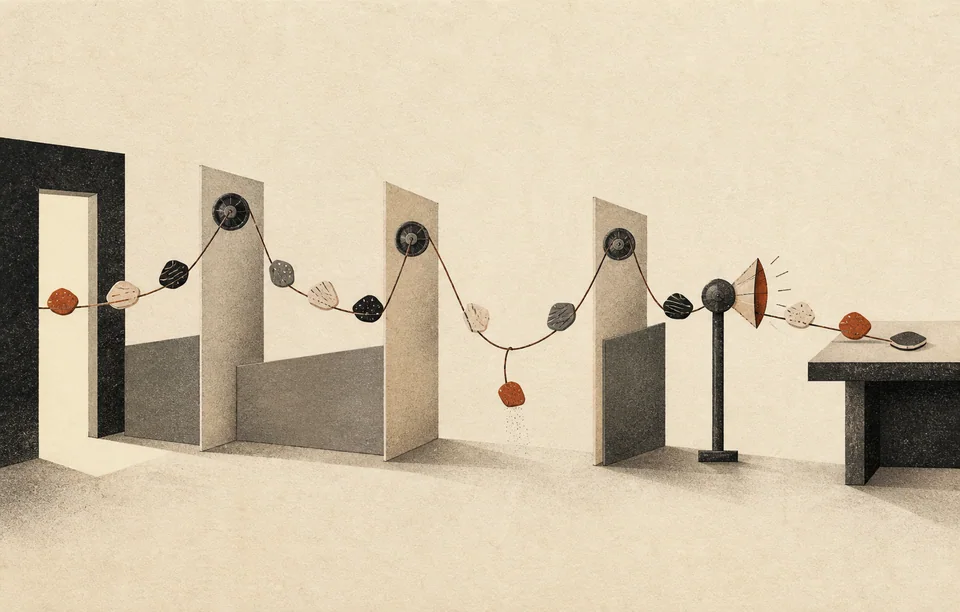
That distance is real because the back office occupies a different vantage point from the clinic. Slack enters the institutional line when a signal leaves the front of care and, by the time it reaches people with the authority to change conditions, has been softened, delayed, mislabeled, or priced out of urgency.
Distance does not require indifference. Context can fall away as a concern travels from the clinic to a decision-maker. A risk arrives as a routine request, and the person who can change the condition may never feel its urgency.
The translation happens in ordinary language: a fall risk becomes an equipment request, a portal barrier becomes an adoption problem, a repeated alert override becomes user behavior, and a seclusion report becomes documentation. Each translation can determine whether the organization treats an early warning as safety information or waits for harm to repeat.
A risk is translated before it is reviewed
In a clinical support setting, I directly saw repeated problems with adult-sized wheelchairs being used for smaller and pediatric patients. I also directly saw a fall in a waiting area. The recurring risk was a mismatch between a person's body, the equipment available, the arrival process, and the queue. Disorganized arrivals and repeated room moves around equipment and queues made the mismatch harder to correct.
I raised the concern through two management levels. When verbal reports produced no visible response, I recorded it anonymously in an employee survey. That is the firsthand account: a repeated equipment problem, a visible fall, an escalation path, and a report that did not produce an obvious next step. I have left out the employer, facility, managers, unit, location, dates, and every patient detail.
The wheelchair is a small object; the conversion problem is larger. Someone close to the work sees a preventable risk. The institution hears a request for equipment, money, space, staffing, or process change. If the line is slack, the warning loses force as it travels. A similar conversion happens when an access-center worker calls a workaround a nuisance, when a portal team calls abandonment a user preference, or when a quality report turns a recurring handoff gap into a denominator.
Health technology creates the same conversion problem in newer forms. An alert, inbox, portal, predictive model, downtime plan, or follow-up queue becomes safer when the organization can hear what happens after the tool touches real work, which means asking whether the people who encounter its defaults can get a signal to someone who can change them.
Keep the line taut
The practical vocabulary for this comes from safety culture and high reliability. AHRQ describes a culture in which people can report concerns and leaders respond without reflexive blame. Its high-reliability primer emphasizes preoccupation with failure, sensitivity to operations, deference to frontline expertise, and resilience. 1 Culture of Safety and High Reliability AHRQ connects reporting culture with sensitivity to operations, preoccupation with failure, resilience, and deference to frontline expertise. Open source Read full Note 1 In practice, sensitivity to operations means paying attention after a policy is written and after a technology goes live, while deference to frontline expertise lets the people closest to the work change what leaders believe about the risk.
A non-punitive response can still lead to a serious review, a changed assignment, or a clear boundary when behavior was reckless; its first obligation is to make the truth easier to tell. The review should then ask what the equipment, interface, staffing model, incentive, handoff, or governance structure made easier than safe work. A punitive reflex can look decisive after an event while making the next weak signal less likely to surface.
When a signal is consequential, the next move should be stronger than a reminder. AHRQ's root-cause-analysis guidance points toward corrective actions that change conditions and measure whether the change held; the Veterans Health Administration's prospective HFMEA/PRA practice similarly asks teams to find failure modes before harm occurs. 2 Root Cause Analysis and HFMEA AHRQ emphasizes stronger corrective actions and follow-up measurement; the VHA method looks for failure modes before harm occurs. Open source Read full Note 2 A wheelchair process may need a reliable fit check and a named owner. A handoff may need a structured field and a receiving acknowledgment. A portal may need a staffed alternative rather than another instruction to try harder.
When technology meets work
The Office of the National Coordinator's current SAFER Guides treat electronic-health-record safety as an organizational self-assessment: responsibility, contingency planning, decision support, test-result follow-up, and clinician communication belong in the same safety conversation. ONC's Patient Safety and Quality Playbook makes a related point about learning across workflow, measurement, and improvement rather than treating an implementation as finished at launch. 3 SAFER Guides ONC treats EHR safety as continuing work across governance, workflow, measurement, communication, and improvement after launch. Open source Read full Note 3
Sittig and Singh's sociotechnical Health IT Safety Framework is useful because it keeps three questions together: is the technology safe, is it being used safely, and can it be used to improve safety? The framework resists a familiar mistake: treating a safety issue as a user problem when configuration, workflow, infrastructure, or organizational policy made the unsafe path the easy path.
Workarounds are not automatically proof of failure. They are clues about the distance between a designed workflow and a livable one. A qualitative study of clinical-informatics teams found that safety work depends on explicit processes for noticing and developing responses to health-technology harm. A separate workaround framework treats workarounds as situated adaptations that can reveal where the formal process does not fit the work. The operating question is therefore specific: what did the worker have to do, what risk did that adaptation introduce, and who has authority to change the underlying condition?
Seclusion, restraint, and the danger of a false alternative
Before clinical operations work, I examined the issue in a seven-page undergraduate paper submitted on December 10, 2023, “Seclusion in Healthcare: Alarming Trends or Data Challenges?” The paper was academic research rather than clinical restraint or seclusion practice. I asked whether treating seclusion as an apparent alternative to restraint can hide the harms that remain when both choices are coercive. Weak definitions, institutional variation, and reporting structure can also make safer alternatives difficult to see.
Current federal hospital rules describe restraint and seclusion as emergency interventions to protect physical safety, require the least restrictive effective response, and require discontinuation as soon as the danger ends. Professional guidance likewise treats seclusion and restraint as last-resort practices that require assessment, documentation, review, and attention to alternatives. 4 Condition of participation: Patient's rights Federal rules and professional standards require an emergency purpose, the least restrictive effective intervention, documentation, review, and prompt discontinuation. Open source Read full Note 4 That standard sets an important boundary while leaving ethical questions that the label “alternative” cannot settle on its own.
Trauma-informed guidance asks organizations to recognize how coercion, fear, power, and previous trauma shape a patient's experience. The APA resource on seclusion and restraint and SAMHSA's trauma-informed approach both put safety, trust, collaboration, voice, and choice in the frame, even when an emergency requires a restrictive intervention. Research on psychiatric inpatient wards describes the ethical strain that remains for patients and staff; the SPICES program treats reduction and substitution with safer practices as an operational project, not a declaration that the problem disappeared. 5 Trauma-Informed Approaches and Programs SAMHSA and APA center trauma and patient experience; the cited research examines the ethical strain and operational work of reducing restrictive practices. Open source Read full Note 5
Measurement can hide a false choice too: the Joint Commission publishes separate measures for physical-restraint hours and seclusion hours, while the federal inpatient psychiatric quality program uses its own reporting structure. 6 HBIPS-2 and HBIPS-3 The Joint Commission counts restraint and seclusion separately, while CMS administers the federal reporting program; neither measure describes the full patient experience. Open source Read full Note 6 Those counters are useful within their limits, and governance still has to ask what they leave out about patient experience, alternatives attempted, and whether a restrictive practice became routine.
The first response is the operating hypothesis
My operating hypothesis is that safety accumulates through the first response to a weak signal. When that response is dismissal, staff can learn that reporting creates effort without change, workarounds become normal, and the next signal arrives with less trust behind it; leaders may see the problem only later, when it is more expensive and more painful to fix.
If the response is disciplined attention, the institution can learn earlier. A basic equipment change, a safer default, a clearer handoff, a better alert rule, a changed escalation path, or a named owner can turn the next report into evidence that the system is listening. Staff confidence can improve because speaking up has an observable consequence. Leaders can get better information because people have less reason to hide risk.
The improvement question I trust is, “What condition made this the path of least resistance, and what will make the safer path easier next time?” It can be asked about a wheelchair, an alert, a portal, a seclusion record, a predictive model, or a queue. Prospective review and event review are different tools, but both should lead to an owner, a changed condition, and a way to notice recurrence.
A taut line gives ordinary work an accurate channel for reporting risk and gives decision-makers enough context to act before an incident makes that risk impossible to dismiss, without requiring leaders to hover over every task.
That is the standard I trust: preserve the real distance between the front of care and the back office while keeping the line between them tight enough that patient-facing reality can still change institutional decisions.
Notes
- AHRQ, “Culture of Safety” and “High Reliability,” Patient Safety Network (2019; reviewed 2024). AHRQ connects non-punitive reporting with sensitivity to operations, preoccupation with failure, resilience, and deference to frontline expertise. Culture of Safety; High Reliability. ↩
- AHRQ, “Root Cause Analysis,” Patient Safety Network (2019; reviewed 2024), and VHA National Center for Patient Safety, “Healthcare Failure Mode and Effect Analysis,” (updated 2026). AHRQ emphasizes corrective action and follow-up measurement; VHA describes prospective review of failure modes. AHRQ Root Cause Analysis; VA HFMEA. ↩
- Office of the National Coordinator for Health Information Technology, “SAFER Guides” (current page, updated 2026), and “Patient Safety and Quality Playbook” (2025); Sittig and Singh, “A New Sociotechnical Model for Studying Health Information Technology in Complex Adaptive Healthcare Systems” (2016); Recsky et al. (2024); and Blijleven et al. (2022). The government guides treat EHR safety as continuing organizational work; the research examines the interaction among technology, workflow, governance, and workarounds. SAFER Guides; Patient Safety and Quality Playbook; Sittig and Singh; Recsky et al.; Blijleven et al.. ↩
- 42 C.F.R. § 482.13, “Condition of participation: Patient's rights,” current regulation, and American Psychiatric Nurses Association, “Standards of Practice: Seclusion and Restraint,” revised 2022. The regulation and professional standard require an emergency purpose, the least restrictive effective intervention, documentation, review, and prompt discontinuation. 42 C.F.R. § 482.13; APNA Standards. ↩
- American Psychiatric Association, “Resource Document on Seclusion and Restraint” (2022); SAMHSA, “Trauma-Informed Approaches and Programs” (updated 2026); Haugom et al. (2019); and Bowers et al., “The SPICES project” (2017). APA and SAMHSA center trauma and patient experience; Haugom and the SPICES project examine the ethical strain and operational work of reducing restrictive practices. APA resource document; SAMHSA trauma-informed approaches; Haugom et al.; SPICES. ↩
- The Joint Commission, HBIPS-2 and HBIPS-3, 2026A manual, and CMS, “Inpatient Psychiatric Facility Quality Reporting (IPFQR) Program,” updated 2026. The Joint Commission counts restraint and seclusion separately, while CMS administers the federal reporting program. Those measures do not describe the full patient experience. HBIPS-2; HBIPS-3; CMS IPFQR. ↩
Sources and methods
The wheelchair account comes from my supervised clinical support work; I have withheld the employer, facility, people, dates, and private records to protect confidentiality. My undergraduate research informs the discussion of seclusion. The numbered Notes identify the public patient-safety and health-IT sources behind specific claims. The institutional-line argument and my interpretation of ordinary friction are my own.
About the illustration