Student research report
Ibuprofen and Radish Growth: Open Student Report
A 2022 student experiment on ibuprofen and radish growth, with the open report, reported measurements, limitations, and credit for all four creators.
Provenance
The four-person group completed the experiment and course report in 2022. Zenodo deposited the report on February 2, 2023 under CC BY 4.0. This site transcription preserves the reported values, adds semantic tables and contextual labels, and makes no independent reanalysis.
Authors: Cole Lyons, Timothy Love, Ren Hart, Shaaheen Khosrowshahi
Version
Experiment and report: 2022 · Zenodo deposit: February 2, 2023 · Site review: July 15, 2026
Open the Zenodo record and report filesStudy identity
This is an accessible record of the open student research report The growth-related effects of 2-(4-isobutylphenyl) propionic acid on Raphanus sativus. Cole Lyons, Timothy Love, Ren Hart, and Shaaheen Khosrowshahi conducted the experiment in 2022 for BIOL 2140 L-04 at UNC Charlotte. The report is not peer reviewed.
Zenodo deposited the work on February 2, 2023 under CC BY 4.0. The stable concept DOI is 10.5281/zenodo.7600108; the current record resolves to version DOI 10.5281/zenodo.7600109. The Zenodo record supplies the downloadable report files and controls the public creator, date, and license metadata.
Research folio
Ibuprofen and Radish Growth: Open Student Report
The photograph and creator record establish the collaborative project context; the tables below transcribe the deposited report's study design and reported measurements.
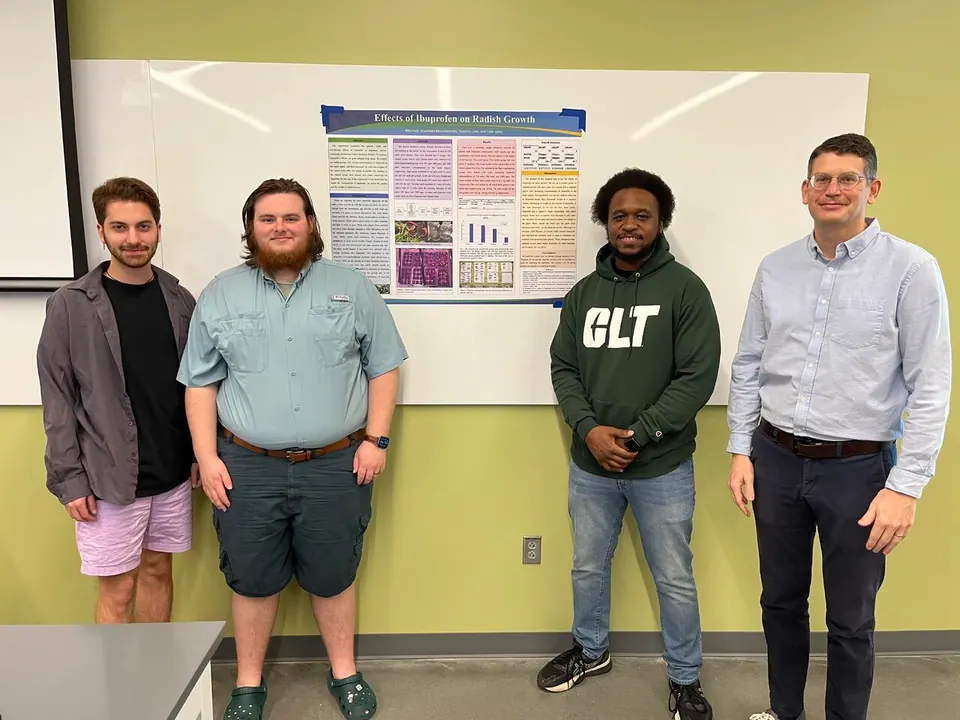
Creators
Cole Lyons · Timothy Love · Ren Hart · Shaaheen Khosrowshahi
Provenance
Experiment and report: 2022 · Zenodo deposit: February 2, 2023
Rights
Report: CC BY 4.0 · Photograph: participant-authorized
What the group studied
The report asked how increasing ibuprofen concentrations in the water supply corresponded with the growth, harvest count, and bulb weight of French Breakfast Radishes. It describes 120 seeds divided equally among a water-only control and three treatment groups.
| Group | Starting allocation | Water treatment |
|---|---|---|
| Control | 30 seeds across two pots | Filtered water |
| 250 ppm | 30 seeds across two pots | 250 ppm ibuprofen solution |
| 500 ppm | 30 seeds across two pots | 500 ppm ibuprofen solution |
| 1,000 ppm | 30 seeds across two pots | 1,000 ppm ibuprofen solution |
The report describes a controlled environment of 65–70°F, 50% relative humidity, and 600 PPFD of light for 12 hours per day during the first seven days. On day seven, selected cells were moved into larger pots. The groups were then watered every three days for 28 days. At harvest, the leaves were removed, the bulbs were washed and weighed individually, and the group recorded counts, sums, and means in Microsoft Excel.
Reported measurements
These values are transcribed from the deposited report. They are presented as the group's reported measurements, not as a new statistical analysis.
Transcription note: The reported mean column does not consistently equal total bulb weight divided by harvested count. The original values are retained below; they have not been silently recalculated.
| Group | Harvested radishes | Total bulb weight | Mean bulb weight |
|---|---|---|---|
| Control | 22 | 187.6 g | 8.53 g |
| 250 ppm | 20 | 184.3 g | 8.38 g |
| 500 ppm | 16 | 144.2 g | 6.55 g |
| 1,000 ppm | 6 | 39.7 g | 1.80 g |
The group reported decreasing harvest count, total bulb weight, and mean bulb weight as concentration increased. The report gives an ANOVA result as “F[4.915]; P=0.003,” but its notation does not provide enough detail for an independent reconstruction. I reproduce that result as reported rather than recalculate it or infer a stronger statistical or causal claim. The report also says visual inspection found no significant morphological differences and notes that histological sampling would be needed for a fuller morphology analysis.
Limitations recorded in the report
The report identifies several conditions that limit interpretation:
- boiling water was repeatedly poured onto the plants;
- too many radishes shared limited pot space;
- the study was small; and
- only six radishes survived to harvest in the 1,000 ppm group.
Within this classroom experiment, the observed pattern was narrower than the title alone might suggest. It establishes no safe concentration, clinical effect, agricultural recommendation, water-treatment standard, or environmental threshold.
Credit, license, and adaptation
Creators: Cole Lyons, Timothy Love, Ren Hart, and Shaaheen Khosrowshahi.
Source: Zenodo concept DOI 10.5281/zenodo.7600108, deposited February 2, 2023.
License: The deposited work is available under Creative Commons Attribution 4.0.
Site adaptation: The tables reorganize the report's study identity, method, measurements, findings, and limitations into accessible HTML. Values are transcribed rather than recalculated. The separately authorized group photograph is not part of the CC-licensed report.