Science's Place in Our Social System
At UNC Charlotte, evolutionary medicine and undergraduate research showed me how societies build reliable knowledge, and why public health depends on carrying evidence into action.
I grew up as one of Jehovah's Witnesses, where I learned to treat evolution as dangerous or false. The conflict involved both the religious and scientific answers and the way each claim arrived: which words were selected, where a quotation stopped, and whether the source's own argument survived the journey.
I remember a recurring pattern across the publications around me. Scientific disagreement or uncertainty could be compressed into a simpler contest between evolution and design. It produced a distorted view of reality, but I did not leave it through one decisive quotation. I learned, slowly, to follow claims farther than the excerpt supplied.
One historically recoverable example shows why that practice matters: a June 2015 Watch Tower article quoted Martin Rees and ended after the thought that humans may never understand some things, while Rees's archived author article continued the same sentence in another direction. I do not know why the excerpt ended there, and it is not the specific quotation I remember encountering. What survives is a clear example of how removing a qualifying clause can reverse the direction of an author's thought.
Source context
Excerpt and source context
-
As excerpted
“There may be things that humans will never understand”
-
The sentence continued
There may be things that humans will never understand but that does not mean they will never be understood
Rees had been considering future post-human or machine intelligence after describing the biosphere as the product of Darwinian evolution. In full, the sentence moves from the limits of human understanding toward the possibility that another intelligence might one day cross them.
A different intellectual possibility
Community-college biology gave me a first working account of evolution. During the COVID era, viral change made evolutionary mechanisms visible as practical explanations for disease and survival rather than as an abstract culture-war topic. Evolutionary medicine then joined the biological mechanism to questions about why bodies remain vulnerable and how those vulnerabilities matter for public health.
When I transferred to UNC Charlotte in January 2021, I pursued a double major in Biology and Public Health with a minor in Medical Humanities. I attended through August 2022 and then transferred again. That academic combination widened my initial clinical ambition: biology asked how living systems change, public health asked what populations need, and the humanities kept human interpretation and value inside the frame.
I emailed Dr. Alex Dornburg because I wanted to understand how evolutionary research was actually done. We met in his office and talked about our experiences, his work, and the questions that had brought me there. I became an undergraduate researcher mentored by him for approximately seven to eight months in the Evolutionary Informatics Lab (EvIL). It was a learning relationship, not an employment or formal appointment.
Evidence has an identity
The lab's subzero storage held preserved fish, small sharks, and stingrays. I cataloged frozen specimens, thawed stingrays, and learned under supervision where to make an incision to access the bowel. I collected fecal material into microtubes while trying to keep tissue and surface contamination from changing what the sample could truthfully represent. Later I taught that procedure to others, including a professor of epidemiology.
Handling the specimens taught me that evidence has an identity: a freezer record connects a specimen to its origin, a tube label connects a sample to the specimen, and careful handling protects that chain. A measurement becomes useful when another person can trace what produced it. I began to understand the statistical and spectrographic work I was learning in R, along with my early encounters with Python, as tools for following the record rather than replacing it.
Evidence identity
Evidence identity across a sequence
-
Specimen
Preserve origin and catalog identity.
-
Sample
Collect the intended material while controlling contamination.
-
Measurement
Keep the value attached to its method and source.
-
Shared record
Make the chain legible enough for another person to inspect.
-
Public action
Use the record with judgment, proportion, and accountability.
A fish-gut microbiome study by Nyholm and colleagues describes sterile handling, separate tubes, and contamination controls in comparable research. My account of the lab procedure, supervision, and my own contribution comes from memory rather than that paper. Keeping those two sources distinct is part of preserving evidence identity.
Knowledge becomes public
In 2022, Cole Lyons, Timothy Love, Ren Hart, and Shaaheen Khosrowshahi designed and ran a student experiment on ibuprofen concentrations and French Breakfast Radish growth. I helped design and execute the experiment, built the grow-tent environment in my apartment, performed measurements, and helped design the group's presentation. The work belongs to all four creators.
The deposited report describes 120 seeds divided among a water-only control and three concentration groups, followed through harvest. It reports fewer harvested radishes and lower aggregate and mean weights as concentration increased. The study also records substantial limitations, including crowded pots, repeated exposure to boiling water, and few survivors in the highest-concentration group. It was an undergraduate experiment, not a peer-reviewed paper and not evidence for clinical, agricultural, or environmental guidance.
Research folio
Ibuprofen and Radish Growth: Open Student Report
A collaborative 2022 student experiment documented by its open report, study record, and group photograph.
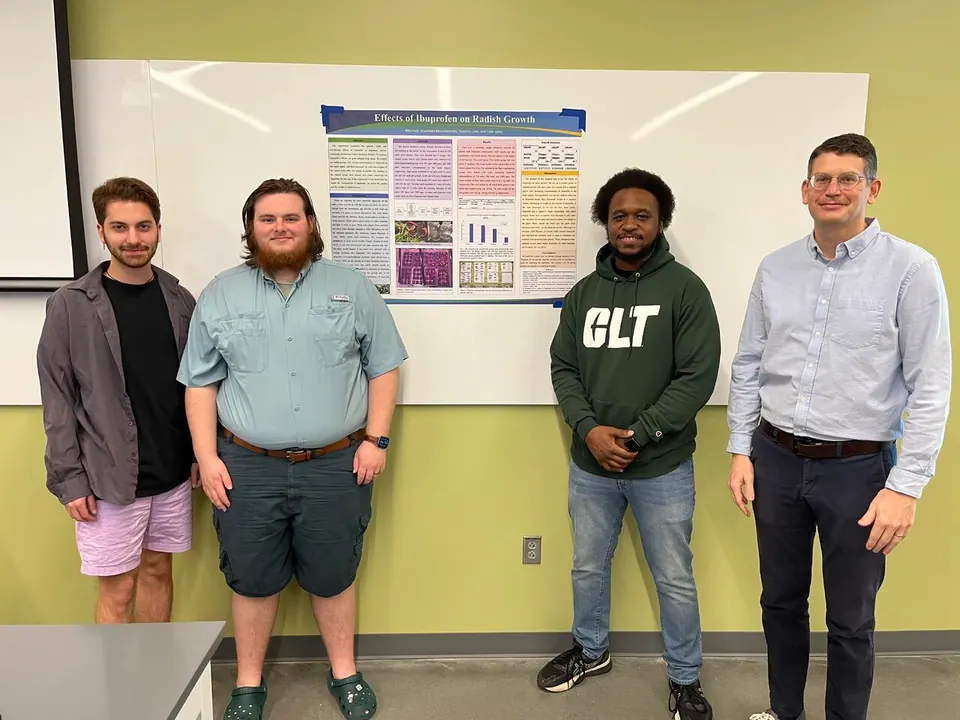
Creators
Cole Lyons · Timothy Love · Ren Hart · Shaaheen Khosrowshahi
Provenance
Experiment: 2022 · Zenodo deposit: February 2, 2023
Rights
Report: CC BY 4.0 · Photograph: participant-authorized
The report was deposited on Zenodo on February 2, 2023 under CC BY 4.0, after the experiment and after my UNC attendance. The original presentation poster is unavailable, so the research folio centers the deposited report: its creator list, design, measurements, findings, limitations, license, and permanent DOI.
As Biology Club communications manager, I planned events and made graphics, flyers, presentations, social posts, and other materials. I helped the club president and other board members plan future events. The role taught me that correct knowledge does not become public on its own. Someone has to explain it, invite attention, and preserve a path back to the source.
Science in the social system
By science's place in our social system, I mean the institutions and practices that let people test inherited claims, build dependable shared knowledge, and direct it toward difficult public problems. No isolated observer can do all of that. Mentors, specialists, protocols, preserved records, criticism, communication, and public institutions make knowledge more reliable. Human judgment still decides which problems matter and what should follow from the evidence.
That idea changed how I understood public health. A brief encounter with the John Snow cholera history helped make the connection: observation, geography, comparison, and intervention can be joined, while no single map or gesture should carry the whole causal story. Public health gave me a way to see scientific knowledge as social capacity rather than an individual credential or collection of facts.
The later colorectal-screening pathway made that capacity concrete. Evidence about screening does not become an intervention until people can identify the eligible population, understand the offer, receive and return a usable kit, obtain a valid result, and reach diagnostic follow-up when needed. The pathway must carry knowledge into action without losing responsibility between steps.
The AJHCS publishing system applies the lesson differently by joining authors, reviewers, editorial independence, accessible publication, and durable records into a public form that readers can inspect. Both later projects continue a practice I learned at UNC: follow the claim all the way down, keep its identity intact, and build the social conditions that let evidence become useful.
Notes
- Watch Tower Bible and Tract Society, “How Science Affects Your Life,” The Watchtower (June 2015). The first-party record establishes the published Rees excerpt. Read the article.
- Martin Rees, “Even a theory of everything has limits,” The Daily Telegraph (September 10, 2012), preserved by the Internet Archive. The archived author article supplies the sentence's continuation and surrounding argument. Read the archived article.
- Evolutionary Informatics Lab and UNC Charlotte CIPHER. The current institutional pages give the lab's public name and Dr. Dornburg's field. My role and contributions are recalled from experience. EvIL; UNC Charlotte profile.
- Nyholm et al., “Gut microbiota differences between paired intestinal wall and digesta samples in three small species of fish,” PeerJ (2022). The article describes sterile handling and contamination controls in comparable research; my procedure, supervision, and contribution are recalled from experience. Read the article.
- Lyons, Love, Hart, and Khosrowshahi, “The growth-related effects of 2-(4-isobutylphenyl) propionic acid on Raphanus sativus,” Zenodo (deposited February 2, 2023). The record controls the creator list, deposit provenance, license, and downloadable report. Open the permanent DOI.
Sources and methods
The education, mentorship, laboratory, student-research, and club experiences are my own account. Public institutional records supply names and dates; the archived Rees article supplies the full quotation; and the group's open report supplies the study design, measurements, and limitations reproduced in the folio. I did not independently reanalyze the experiment.
About the illustration