A Publication Needs an Operating System
Building and running AJHCS: shared authorship, independent editorial decisions, the cost of publishing, and the software behind an open-access journal.
Role
President & Co-Founder
AJHCS August 2023–present
My role and where the work stands
My role in the work
AJHCS is jointly built. Syed Siddiqi originated the journal and led founding vision, editorial governance, listing work, and much of its sales relationship-building; Zach Carsey created the visual identity; Luis Barragan, DBA, MHA, the editorial team, podcast leaders, and many contributors shaped the institution. Cole and Syed shared institutional growth and commercial development. Cole became the operating and technical executor: podcast operations, guest recruitment, editor management, current website production, technology and AI systems, operating efficiency, and personal design, implementation, and maintenance of AJHCSv3 and every later technical generation.
Where it stands
A jointly built open-access healthcare strategy publication and platform with protected scholarly editorial authority, 12K+ subscribers, 200+ podcast episodes, 20+ interns and early-career contributors, and a custom Cloudflare-backed publishing system in production. Financial and traffic measures remain separately defined.
Contents
In August 2023, Syed Siddiqi sent me a message about the journal he wanted to build. He brought the founding idea and a conviction that healthcare strategy deserved an open-access scholarly home. I saw a chance to help turn that idea into an institution and said yes. AJHCS was founded that month, before either of us knew how much work the promise would require.
The early website made the journal visible, while the responsibilities of recruiting guests, editing episodes, protecting scholarly decisions, explaining a sponsor's value, supporting contributors, assigning reviewers, and keeping sources citable accumulated one by one. Over time, the word publication came to mean a system of people, authority, evidence, capital, and code.
A publication's operating system joins editorial authority, commercial proof, contributor development, and software into one institution that can earn trust over time; frontier AI changed how much of that system one committed operator could build, while disciplined orchestration and retained human authority made the added capacity usable.
AJHCS was built through shared authorship
AJHCS is jointly built: Syed supplied the founding vision, originated the scholarly journal, led editorial governance and listing work, and became the stronger relationship-builder in sales, while I became the operating executor. We shared conference promotion, executive and board recruitment, institutional growth, and commercial development.
The work widened around us: Zach Carsey's logo, colors, typography, and visual identity gave AJHCS a recognizable public character; Luis Barragan, DBA, MHA, the current Editor-in-Chief, and the broader editorial team materially shaped the written publication; Vrushangi Shah, MHA, and Zachary McConnell, MA, PA-C, materially expanded the podcast and its reach; and guests, editors, scholarly authors, interns, early-career contributors, board members, and other team members carried essential parts of the institution.
My contribution sits inside that shared institution: I built and ran the podcast system, recruited guests, employed and managed podcast editors, implemented new workflows against Syed's expense-reduction targets, and took responsibility for the current website, technical operations, and AI systems. I personally designed, built, and maintain AJHCSv3 and every technical generation after it.
Selected institutional credit
Who built the institution
These are the major roles needed to understand the operating story; the list is not an exhaustive roster of the people who contributed to AJHCS.
- Syed Siddiqi
- Origin and editorial governance Originated the journal, supplied its founding vision, led editorial governance and listing work, and became the stronger relationship-builder in sales.
- Zach Carsey
- Visual identity Created the logo, colors, typography, and recognizable visual identity that gave the publication an authoritative public presence.
- Luis Barragan, DBA, MHA, and the editorial team
- Scholarly publication The current Editor-in-Chief and the broader editorial team materially shaped the written publication and its scholarly judgment.
- Vrushangi Shah, MHA, and Zachary McConnell, MA, PA-C
- Podcast development Materially expanded the podcast and its reach alongside the guests, editors, and other contributors who made the library possible.
- Cole Lyons and Syed Siddiqi
- Shared institutional growth Shared conference promotion, executive and board recruitment, institutional growth, and commercial development.
- Cole Lyons
- Operating and technical execution Built and ran the podcast system, recruited guests, employed and managed editors, implemented operating efficiencies, and personally designed, built, and maintained AJHCSv3 and every later technical generation.
My operating decisions and technical work belong within that shared effort. Understanding who contributed and who held authority is essential to understanding how AJHCS was built.
Each platform generation earned the next one
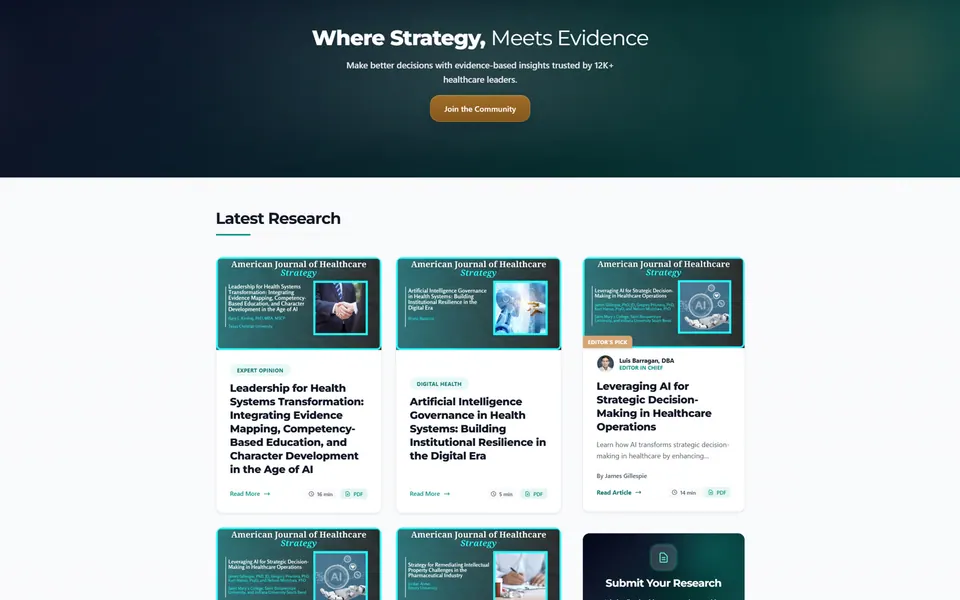
AJHCS began on GoDaddy Sites, a first presence that did what a young publication needed by giving early work a public address and letting the team learn through publishing. The next generation, a professionally designed custom WordPress site, took months of design and development and an investment of approximately $15,000, giving the journal a more credible reading experience and expressing Zach's identity with care.
Over time, the cost, elapsed time, and limits on operator control changed the build-versus-buy calculation. Early GPT-4 and GPT-4o assistance helped me understand cPanel, diagnose the existing system, and make targeted changes. Later agentic tools, including Antigravity, Claude, Codex, and the frontier models that followed, expanded the feasible unit of work from a cautious edit to an end-to-end publishing capability. They expanded what I could build. They did not build the institution or assume responsibility for it.
Platform evolution
Each generation earned the next one.
The sequence is a build-versus-buy record, not a story in which old technology failed and AI suddenly made everything easy.
-
Founding presence
GoDaddy Sites
Value retainedA fast public home for a new journal: enough to publish early work, learn what readers needed, and make the institution visible.
Decision pressureThe hosted surface could establish presence, but it offered little control over scholarly workflows or the reading system.
-
Professionalizing generation
Custom WordPress
Value retainedMonths of design and development, and an investment of approximately $15,000, translated Zach Carsey's identity into a credible custom publication.
Decision pressureThe generation created real brand and publishing value. Its cost, elapsed time, and limited operator control later supported bringing more of the system in-house.
-
Operator-controlled system
Custom Cloudflare-backed publishing
Value retainedAJHCSv3 and the generations after it joined the public reading experience to submission, author, review, decision, DOI, notification, and audit-trail capabilities.
Decision pressureIn-house control replaced some licensing dependence with a permanent obligation to maintain the software, protect sensitive administration, and prove each release.
The current custom Cloudflare-backed publishing and administration system is fully in production by my firsthand account. It supports submission intake, author records, role-based access, reviewer assignment, single-blind review, conflict and recusal handling, revision rounds, editorial decisions, publication state, DOI and Crossref handling, notifications, and an audit trail. Together, those capabilities create workflow control and reduce licensing dependence while bringing a permanent maintenance and security obligation. I keep sensitive administration and infrastructure details private.
The WordPress generation professionalized AJHCS, taught us what a publication interface had to carry, and revealed where control mattered enough to justify ownership. Each generation earned the evidence for the next decision, so the custom system grew from what its predecessor had made possible and visible.
Scholarly decisions retain their own authority
The most important boundary in the operating system is not technical. The AJHCS scholarly journal has protected editorial authority outside founder and commercial control. Its Editor-in-Chief and protected editorial decision-makers cannot be removed by Syed or me. Founder or commercial authority does not determine scholarly acceptance, conclusions, scheduling, or review outcomes.
The current AJHCS Author Center defines the scholarly journal's process as single-blind peer review. The broader AJHCS institution also produces podcasts, practitioner publications, sponsorship, research support, educational work, and other formats. Their status has to remain visible because a reader should not have to guess whether a piece is peer reviewed, sponsored, advertised, or editorially independent.
Institutional and scholarly-editorial firewall
Scholarly authority remains separate within one institution
Permitted commercial formats include clearly identified podcast sponsorship and sponsored episodes, podcast and website advertising, advertising adjacent to research, funding research capacity in a subject area, and clearly labeled op-eds, sponsored content, and other non-peer-reviewed work under the applicable terms. Podcast sponsors do not receive full editorial control. Payment never purchases scholarly publication, favorable findings, peer-review status, indexing, citations, or concealed influence.
Editorial independence has to hold in practice: decisions, disclosures, recusals, and visible format labels. It also requires refusing money that asks for the wrong kind of control.
Commercial buyers ask for a different kind of proof
My first major commercial assumption was almost exactly backward: I expected funding to be difficult and sales to be straightforward. A novel, ambitious idea with credible founders and early execution can attract investment, advice, time, or other resources because a backer can imagine substantial upside. A buyer asks for something more exact: who will this reach, what concrete value will it create, can the offer be delivered reliably, and how will either side know?
AJHCS received approximately $50,000 in seed funding and, separately, approximately $100,000 in cumulative gross cash revenue from August 2023 through July 2026. That revenue was spent operating and developing AJHCS; it does not represent profit, valuation, outstanding commitments, contracted pipeline, an audit, or proof of financial sustainability.
Editorial quality creates reader value. Commercial operation needs an additional evidence layer: audience definition, targeting, attributable delivery, measurement, and client reporting. Large advertising platforms are instructive here because they make commercial value legible, not because their content is inherently better. Search engine optimization and generative engine optimization can improve discovery; durable information value still comes from original synthesis, practical applicability, or a proof point a reader can responsibly use.
The strongest use signal I can point to is deliberately small. A May 2025 CDC Targeted Assessment for Burnout implementation guide lists Jeff Bray's AJHCS article, Navigating the Crisis: Strategies for Addressing Healthcare Staffing Shortages, as a workforce resource. A later published leadership paper cites that article formally. Those are two documented uses of one article, not blanket validation of AJHCS.
Human authority makes AI-assisted engineering usable
The custom system became possible as the capability environment changed, but the durable method is organizational. By the AJHCSv3 phase, I work through spec-driven, end-to-end slices: one bounded change per pull request, explicit ownership and acceptance criteria, focused tests followed by full proof, responsive browser evidence, and an independent review–repair–confirmation pass before merge.
A persistent orchestrating agent integrates specialist workstreams with defined scopes. I retain authority over architecture, editorial meaning, editorial independence, rights, security, confidentiality, clinical and public-safety implications, and irreversible production changes. Releases use explicit rollback paths, blast-radius review, recoverable backups, owner gates for irreversible actions, and branch and deployment restrictions. Generated code does not make a release safe, and some deployments still require manual recovery rather than an atomic rollback.
Evidence-qualified production now operates as a set of explicit capability contracts: an authority registry records who may decide, a structural source inventory defines what the release depends on, recovery validation tests whether the system can be restored, and performance baselines become regression contracts rather than one-time screenshots. Route, schema, and provider gates must pass into a qualification manifest before a scoped release can proceed. This is the capability-level account of the system, while administrative paths, infrastructure topology, and operational commands remain private.
Since March 2026, I have often finished my day job and put approximately another 40 hours per week into AJHCS, a small-team operating constraint that made weak coordination expensive and disciplined delegation necessary. The useful question became, “Can I define the authority, evidence, proof, review, and rollback conditions well enough to own the result?”
The answer changed my role. I still write code, but more of the work now lies in specifying the whole slice, assigning clearly scoped ownership, reading every material diff, inspecting the rendered result, and deciding what no agent has authority to decide.
Contributor development creates a place to practice
Across its history, AJHCS has involved more than 20 interns and early-career contributors. The institution has repeatedly attracted people willing to do difficult work: real assignments, editorial feedback, interviews, publication, and professional relationships. Contributors have later entered law school, PhD study, residency, employment, and other advanced work.
Those later paths are heterogeneous and were never a predefined outcome measured through formal follow-up, so AJHCS should not claim to have caused them. Their accomplishments primarily reflect their own talent and labor; AJHCS's narrower, honest contribution was to create a place where people could practice in public, receive feedback, build relationships, and show what they could do.
The same discipline applies to audience and finance. Subscribers, podcast episodes, page requests, downloaded bytes, contributors, seed funding, and gross cash revenue answer different questions. Adding them together would make the number larger and the evidence worse.
Dated operating ledger
Seven measures. No blended reach number.
| Measure | Reported value | Window or basis | Interpretive boundary |
|---|---|---|---|
| Subscribers | 12K+ | Current AJHCS public reporting | Subscriber count; not combined with requests, downloads, or podcast episodes. |
| Podcast library | 200+ episodes | Current AJHCS public reporting | Published episode count; not a listener or download count. |
| Page requests | >1 million monthly | Cloudflare rolling 30-day dashboard, observed July 2026 | Human and automated traffic; not readers, visitors, article reads, or comprehension. |
| Data transferred | ≈100 GB | Cloudflare rolling 30-day dashboard, observed July 2026 | Downloaded bytes across traffic; not an audience count. |
| Contributors | 20+ | Interns and early-career contributors across AJHCS history | Heterogeneous participation, not employees or a measured placement cohort. |
| Seed funding | ≈$50,000 | Cole-authorized cumulative figure | Funding received; kept separate from revenue. |
| Gross cash revenue received | ≈$100,000 | August 2023 through July 2026 | Cumulative cash received and spent operating and developing AJHCS; not profit, valuation, pipeline, or audited sustainability. |
The operating system is the publication
I used to think of the website as the platform and the editorial work as the publication. Building AJHCS collapsed that distinction. Every public page depends on decisions about authority, format, contributor care, commercial proof, software ownership, and operating cost.
The system is durable when each part keeps its own definition: requests describe traffic while subscribers describe a distinct public relationship; gross cash revenue records money received while seed funding records capital; and sponsorship and scholarly acceptance move through separate authority. Software supports editorial work without owning it, AJHCS gives contributors a place to practice in public while their later success remains their own, and my work remains one contribution within that collective authorship.
AJHCS still has work to do, as any living publication does. The lesson I would carry into another knowledge institution begins with deciding who has authority, what evidence a buyer and reader can inspect, how contributors will be treated, which capabilities deserve ownership, and where a human must remain responsible. Once those commitments are clear, build the smallest operating system that can keep them over time.
Notes
The AJHCS About page, scholarly journal, Author Center, and commercial information describe the institution publicly. Operational facts come from my firsthand account. Where those pages conflict, I use the policy and figures confirmed for July 2026 instead of combining incompatible statements.
The CDC TAB implementation guide and the later published leadership paper document two external uses of Jeff Bray's staffing article. Neither source evaluates AJHCS as an institution.
Financial, contributor, Cloudflare, platform-production, and work-method facts come from my firsthand account. Their source and date scopes remain visible, and they are not independently audited operating results.